
00
A concise record of education, teaching and work.
The route of his training can be read clearly through a few anchor facts: residential study, rigorous lineage, teaching responsibility, university degrees and sustained practice in Rourkela.
- Residential study Ayodhya and Prayagraj from 16 May 1998 onward
- Teaching responsibility Served as Pracharya at Shri Eknath Ved Pathshala, Paithan
- Formal qualifications Shastri and Acharya degrees from Sampurnanand Sanskrit University
- Continuing work Jyotish, Vastu, Karmakand and spiritual guidance in Rourkela since 2005
01A
Honours and institutions
Recognition from respected Vedic and religious institutions.
Institutional honours and associations included in the professional profile of Acharya Pt. Binod Shastri.
- Honoured by Vedashastrokt Sabha, Pune
- Institution Mukteshwar Devalaya, Juhu, Mumbai
- Honoured by Chaturved Sansthan, Kashi, Varanasi
From Korane to residential study.
Religious education and daily discipline formed part of his childhood. After completing Class 6 and entering Class 7, his father sent him to Ayodhya for full-time Vedic education.
He later continued at Maharishi Mahesh Yogi’s Brahmapuri Ashram in Prayagraj. In 1999, an oral examination in Vedic mantras, Sandhyavandan, Durga Saptashati, Rudradhyaya and daily religious practice led to his selection for the Ashtavinayak programme in Maharashtra.
The route of his education
Korane → Ayodhya → Prayagraj → Chhatrapati Sambhajinagar → Paithan and the Ellora region → Rourkela
Education and work, in sequence
-
Korane, Bihar
Raised in a Shrotriya Brahmanishtha family in which Vedic rites and Karmakand were practised across generations.
-
Ayodhya
Entered Maharishi Mahesh Yogi’s Ashram for residential Vedadhyayan.
-
Prayagraj
Continued Vedic education at the Brahmapuri Ashram under several subject-specific teachers.
-
Ashtavinayak programme
Selected through an oral examination covering Vedic mantras, Sandhyavandan, Durga Saptashati, Rudradhyaya and daily practice.
-
Chhatrapati Sambhajinagar
Studied at Sant Dnyaneshwar Ved Vidya Pratishthan under Pandit Durgadas Mule Ji, with training in Yajurveda, recitation, Karmakand, ceremonial preparation and Vastu.
-
Ellora and Grishneshwar region
Received mantra diksha and sustained Sri Vidya instruction from Sri Sri 108 Vamdev Saraswati Ji of the Dattatreya tradition.
-
Paithan
Served as Pracharya of Shri Eknath Ved Pathshala and taught twelve students in Vedadhyayan. Three of his students were later selected at a major Vedic gathering connected with the Kanchi Kamakoti tradition.
-
Maharashtra and Varanasi
Continued Vedic and mantra study under Ghanpathi Vedmurti Shri Narayan Godse Guruji, including portions of the Shatpath Brahman; studied Ganita and Phalita Jyotish; obtained Shastri and Acharya degrees from Sampurnanand Sanskrit University.
-
Rourkela
Continues work in Jyotish, Vastu, Karmakand, ritual preparation, Sri Vidya and spiritual guidance.
Principal teachers
Yajurveda, Karmakand and Vastu
Pandit Durgadas Mule Ji
Founder and head of Sant Dnyaneshwar Ved Vidya Pratishthan. Under his guidance, study extended into direct ceremonial work, travel with senior teachers and practical responsibilities at homes, institutions, factories and industrial sites.
Sri Vidya and mantra diksha
Sri Sri 108 Vamdev Saraswati Ji
A sanyasi and practitioner of the Dattatreya tradition who gave him mantra diksha and sustained instruction in Sri Vidya.
Vedic, mantra and Shatpath Brahman study
Ghanpathi Vedmurti Shri Narayan Godse Guruji
Continued his specialised learning in Vedic and mantra disciplines, including portions of the Shatpath Brahman.
What he studied and taught
Veda and Yajurveda
Residential recitation, textual study, daily observance and direct correction by teachers formed the base of his education.
Karmakand
Training included preparation, sequence, materials and participation in yajnas, family rites and collective ceremonies.
Vastu
Learning was applied to homes, institutions, factories and industrial sites rather than treated only as textual theory.
Sri Vidya
He received mantra diksha and sustained instruction within the Dattatreya tradition, with the discipline and boundaries proper to that tradition.
Ganita Jyotish
Mathematical and astronomical calculation used in the construction and reading of astrological time.
Phalita Jyotish
Interpretation of planetary periods, combinations and the relation between timing and the person’s specific question.
Teaching
As Pracharya in Paithan, he taught twelve students and guided them through daily Vedadhyayan.
Shatpath Brahman
Portions of this major Vedic prose text were studied under Ghanpathi Vedmurti Shri Narayan Godse Guruji.
Education and work in photographs.
The photographs record public religious programmes, collective ceremonies and earlier institutional work.
New in the visual record
Recent sacred observances.
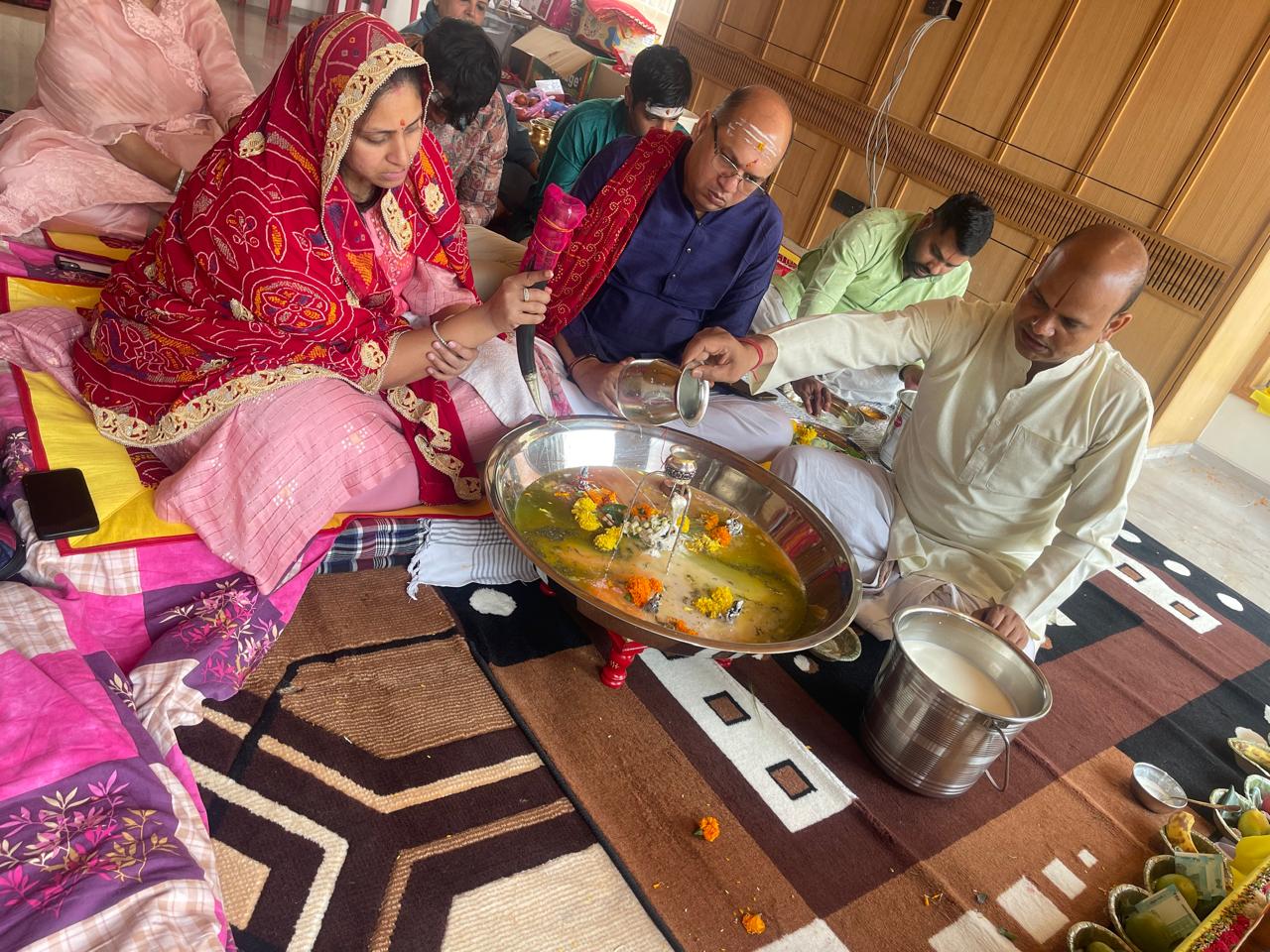
A newly added record of Shiva worship, yajna, floral adornment and ritual preparation. The photographs and films are presented with their original framing intact.
A visual record of teaching, ceremony and practice.
Selected photographs from teaching, public recitation, ceremonial work and sacred arrangements. Each image opens at its original resolution.
Formal study and practical responsibility developed together.
His work brings together textual learning, calculation, interpretation, ritual procedure, teaching and long experience with personal and institutional questions.